
Editing is rarely a single pass, and planning enough time for it is one of the best things you can do for your book. Here is what determines how long it takes.
Every editing quote Potter Publishers sends includes an expected delivery date, because timing matters as much as cost when you are planning a launch. Here is how we think about editing schedules, and how to build a realistic one for your book. For the steps from manuscript to launch, see our 90-day publishing roadmap.
What affects the timeline
- Editorial stage. Developmental edits take longest; proofreading is usually quickest.
- Word count. Longer manuscripts take longer.
- Condition of the draft. Cleaner drafts move faster.
- Your revisions. After each edit you need time to review and revise.
- Editor availability. Good editors are often booked ahead.
A typical sequence
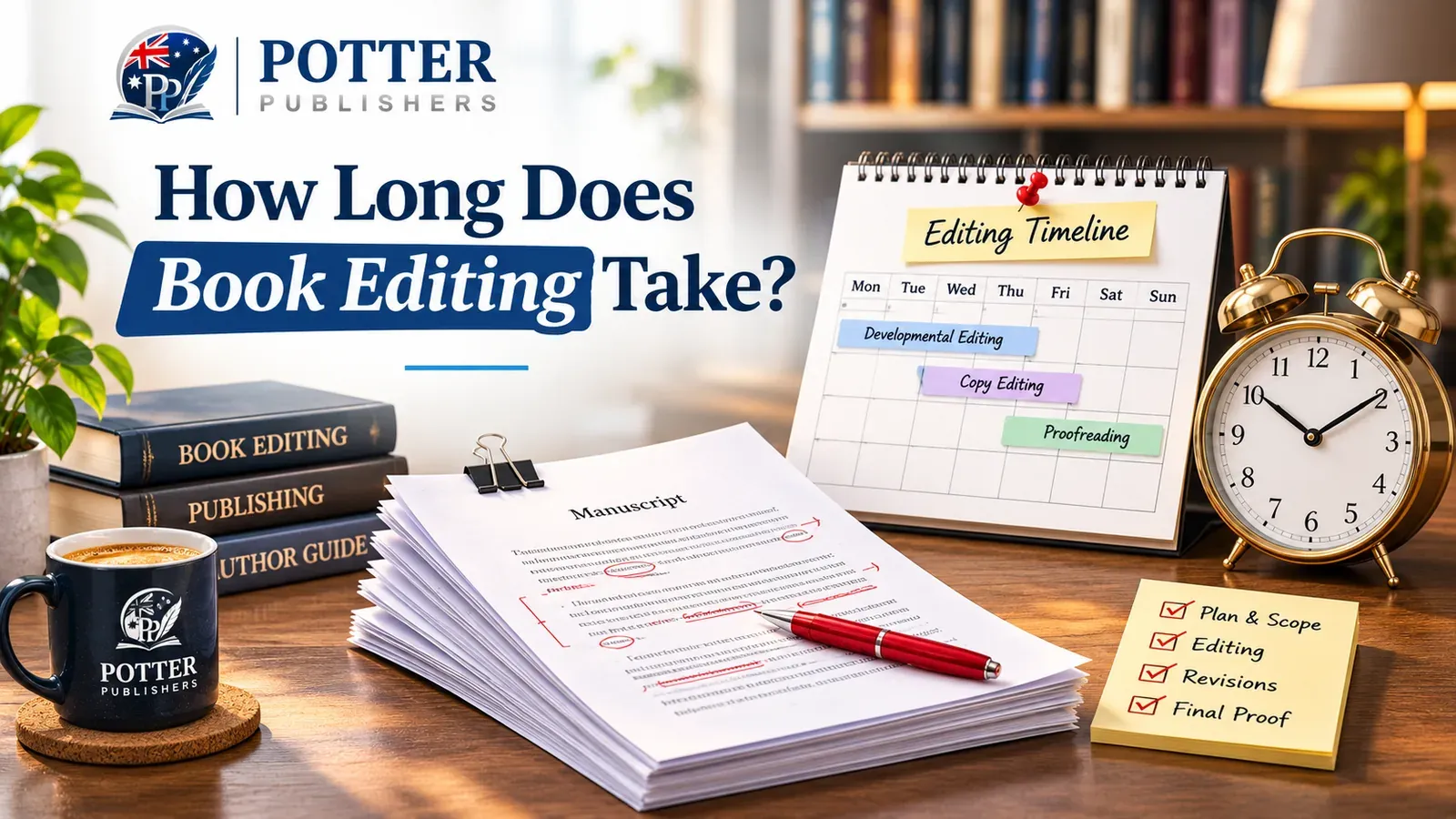
Most books move through developmental editing, revision, line or copy editing, formatting and a final proofread. Each step depends on the last, so the total timeline is the sum of the edits plus your revision time between them.
How to keep your schedule on track
Book your editor early, agree dates in writing, and set aside time to revise between rounds. If you have a launch date, work backwards from it and allow a buffer.
Why each stage takes the time it does
A developmental editor has to read and understand the whole book before writing a word of feedback, then think through how its parts fit together, which is why it is the slowest stage. A line editor works carefully through every paragraph. A copy editor checks consistency across the whole manuscript, which means tracking names, dates and terms from the first page to the last. A proofreader reads slowly by design. None of these can be done well in a rush.
Your revision time counts too
Authors often plan for the editor's time and forget their own. After a developmental edit you may need weeks to restructure chapters, add scenes or cut material. After a copy edit you need time to review every tracked change and answer queries. Build this into your plan, and be honest with yourself about how much time you can give the book each week.
Building a realistic schedule
- Start from your target publication date, if you have one.
- Work backwards: launch preparation, printing and proofs, formatting, proofreading, copy editing, revision, developmental editing.
- Ask each editor for their delivery date when you book, not when you send the manuscript.
- Add a buffer between stages for revisions and unexpected delays.
- If the dates do not fit, move the launch rather than squeezing the edit.
Booking ahead
Experienced editors are often booked in advance, particularly at busy times of year. Contacting editors while you are still finishing your draft, and booking a date for when it will be ready, keeps the project moving.
What can cause delays
- Sending the manuscript later than the booked date
- Major rewrites after an edit that need a further pass
- Slow responses to queries
- Adding new chapters after the copy edit
Signs your editing schedule is too tight
If you find yourself skimming editorial notes, accepting all changes without reading them, or skipping the proofread to meet a date, the schedule is working against the book. A short delay before publication is far less costly than a book that goes out with avoidable problems.
Communication keeps editing on schedule
Clear communication with your editor prevents most delays. Confirm the delivery date and format of the manuscript in advance, tell the editor early if your draft will be late, and reply to queries promptly. If you plan to be away during the edit, mention it, so the editor can schedule questions for when you are available.
Planning editing around a launch date
A launch date gives a project focus, but it should be set with editing in mind. Once you have quotes and delivery dates from your editors, add the time you need to revise between stages, then the time for formatting, proofreading, printed proofs and launch preparation. If the resulting date is later than you hoped, it is usually better to adjust the launch than to compress the editing.
Editing a series
For a series, editing time per book often decreases once the editor knows your world, characters and style. A series style sheet and story bible help each book move faster, because decisions about names, places and terminology are already recorded. Booking your editor for future books in advance also helps keep a regular release schedule.
What to do while your book is being edited
Editing time is a good moment to work on everything else the book needs: researching comparable titles and categories, drafting your book description and author bio, planning your cover brief, setting up your author website and email list, and starting on launch planning. When the edit comes back, you will be ready to revise and move on to production without delay.
Key takeaways
- Developmental edits take longest; proofreading is usually quickest.
- Your own revision time between stages is part of the schedule.
- Book editors early and agree delivery dates in writing.
- Work backwards from your launch date and include a buffer.
- Move the launch rather than rushing the edit.
A realistic schedule protects the quality of your book. When every stage has enough time, editing becomes far less stressful, and the finished book is ready for readers when you launch.
How Potter Publishers can help
Every quote we send includes an expected delivery date for the agreed stage. Explore our book editing services and manuscript assessment.
Related reading
- Book editing costs explained
- Developmental editing vs copy editing
- A 90-day book publishing roadmap
- Book launch checklist
Questions and next steps
Can editing be rushed? Sometimes, but quality and scheduling may suffer. Plan ahead where possible.
Read next: developmental editing vs copy editing.
Does a shorter book edit faster? Generally yes, but complexity and the condition of the draft matter as much as length.
Can I write my next book while this one is being edited? Many authors do, though it helps to keep time free for revisions when the edit comes back.
Planning a launch date? Potter Publishers can schedule editing, design and publishing around it. Plan your timeline with us.