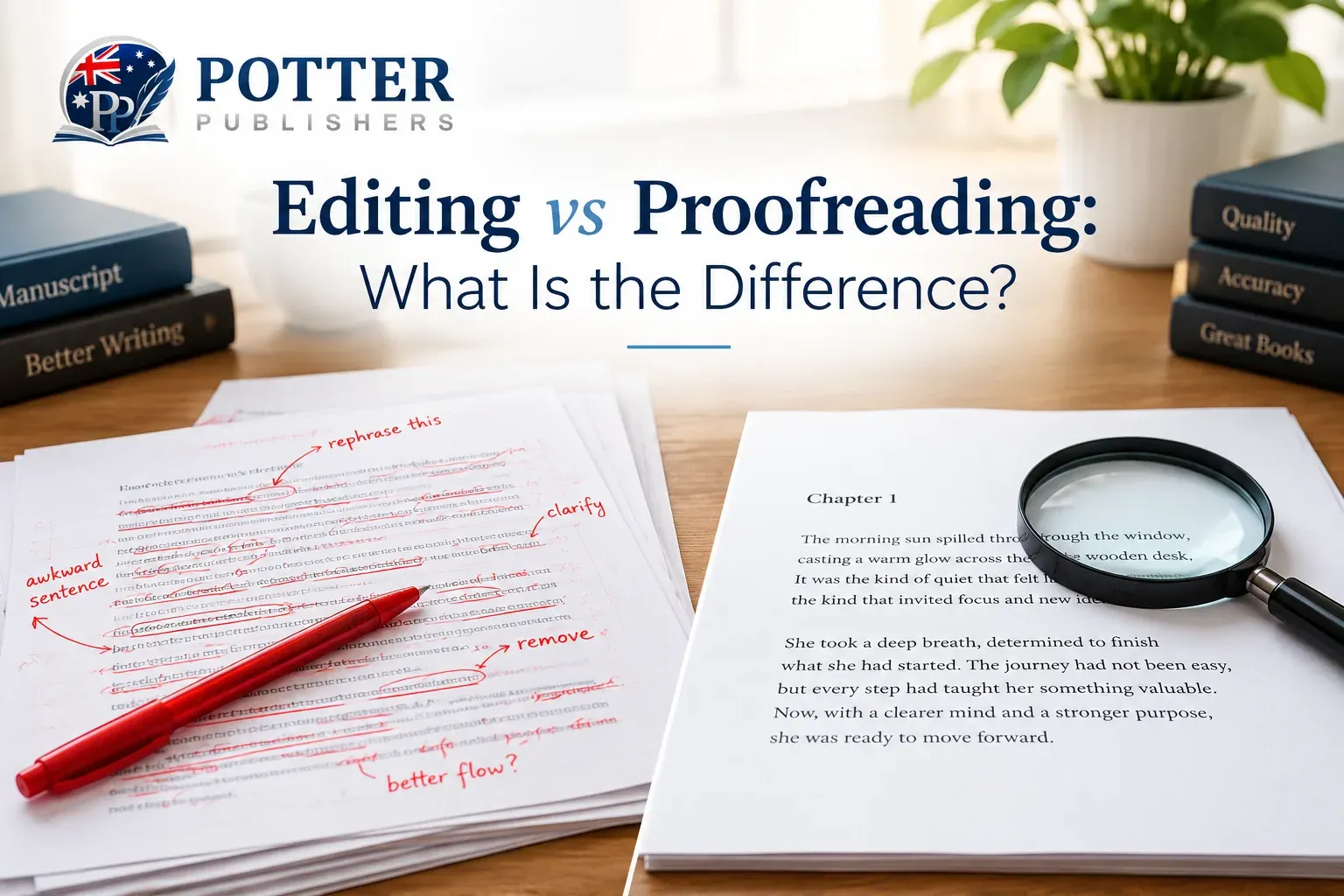
Editing and proofreading are often used as if they mean the same thing. They do not, and confusing them can leave a book with problems that no amount of proofreading will fix.
At Potter Publishers we often receive manuscripts booked in for "a quick proofread" that actually need editing first. Getting the order right saves authors money and gives a better book, which is why our team assesses every draft before recommending editing or proofreading.
What editing does
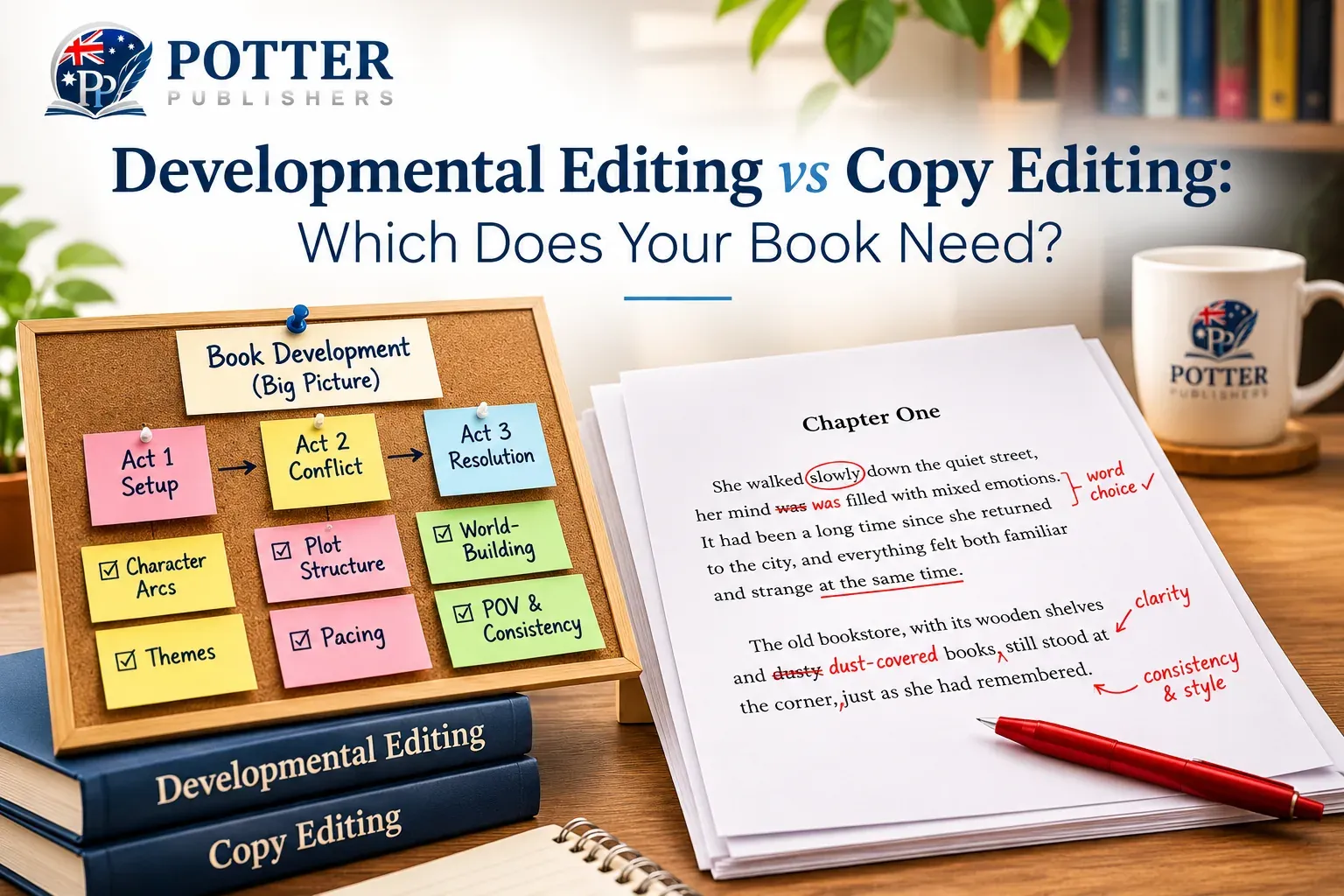
Editing improves the writing itself. Depending on the stage, an editor may restructure chapters, strengthen character arcs, clarify an argument, tighten sentences or correct grammar and consistency. Editing changes the text, sometimes substantially, and usually happens over more than one round.
What proofreading does
Proofreading is the final quality check. A proofreader reads the edited text slowly, ideally after it has been formatted, to catch typos, missing or repeated words, punctuation slips and layout problems such as stray line breaks, wrong headers or broken page numbers. Proofreading does not rewrite; it polishes.
Why the order matters
Proofreading before editing wastes money, because the editor will change much of the text and introduce new places for errors. The usual order is: developmental edit, line edit, copy edit, formatting, then proofreading of the formatted file.
Which one do you need?
- If you are not sure the story or argument works, you need editing, starting with a developmental edit.
- If the book has been professionally edited and formatted, you need proofreading.
- If you self-edited carefully, a copy edit followed by a proofread is often the right combination.
A worked example
Consider a single paragraph from a draft novel that repeats the same information twice, slips from one character's point of view into another's, and contains a misspelled place name. An editor would restructure the paragraph to remove the repetition, flag or fix the point-of-view slip, and correct the spelling. A proofreader, reading the same paragraph after editing and formatting, would check that the corrected spelling now matches every other mention, that no words were dropped in layout, and that the line does not end with a single stranded word at the top of the next page.
Both jobs are about quality, but they operate at different depths and at different points in the process.
What each one does not do
An editor is not primarily checking layout, page numbers or running headers, because those do not exist until the book is formatted. A proofreader is not there to tell you the middle of your book drags, that a character is unconvincing or that an argument needs another chapter. Asking a proofreader for editorial feedback, or an editor for a layout check, sets both up to disappoint.
Signs your book needs editing, not just proofreading
- Readers say they lost interest partway through.
- You are unsure whether the opening is strong enough.
- Sentences feel wordy or repetitive when you read them aloud.
- Names, timelines or facts are inconsistent across chapters.
- You have not had any professional feedback on the manuscript yet.
Signs you are ready for proofreading
- The manuscript has been professionally edited.
- The text is final and you do not expect further rewrites.
- The book has been formatted for print or ebook.
- You have a style sheet recording key decisions.
How the two fit into a publishing timeline
A typical sequence runs from a finished draft to a developmental edit, revision, a line or copy edit, formatting, and a proofread of the formatted file, followed by final corrections and approval of the proof. Proofreading sits deliberately near the end, after the text has stopped changing.
What a professional proofread delivers
A professional proofreader works methodically through the whole book, often more than once, checking spelling and punctuation, repeated or missing words, consistency with the style sheet, and the layout itself: headers, page numbers, chapter openings, captions and the table of contents. Corrections are usually marked on the proof or listed page by page, so your typesetter can apply them quickly and accurately.
Many proofreaders also raise queries: places where something looks wrong but they cannot be sure what you intended. These are flagged for your decision rather than changed silently, because at this late stage the author should approve every change.
What a professional edit delivers
An edit typically returns the manuscript with tracked changes and comments, so you can see every suggestion and accept or reject it. Depending on the stage, you may also receive an editorial letter summarising the main issues, and a style sheet recording decisions for the rest of the process. Unlike proofreading, editing expects you to make choices and often to revise.
Can software replace either?
Grammar and spelling tools are useful for catching obvious slips as you write, and many authors run them before sending a manuscript to an editor. They are not a substitute for a human editor or proofreader. Software misses errors that are correctly spelled but wrong in context, struggles with dialogue, voice and deliberate style choices, and cannot judge whether a scene works or an argument holds together.
Getting the most from each stage
- Before editing, share your goals for the book and any concerns you already have.
- Read editorial comments carefully; they often explain the reasoning behind a change.
- Before proofreading, make sure the text is truly final.
- Give the proofreader your style sheet so they apply the same decisions.
Key takeaways
- Editing improves the writing itself; proofreading catches the errors that remain once the text is final.
- Proofread after formatting, because layout introduces its own mistakes.
- Doing the stages out of order wastes money, since edited text changes.
- A fresh proofreader catches more than someone who already knows the text.
- Software helps while drafting, but it does not replace a human editor or proofreader.
If you are unsure which stage your manuscript needs, start with an honest assessment rather than guessing. Choosing the right service at the right time is one of the simplest ways to protect both your budget and the quality of your book.
How Potter Publishers can help
We can assess your draft and tell you honestly which service it needs. Explore our book editing services, copy editing and proofreading services.
Related reading
- Developmental editing vs copy editing
- Book editing costs explained
- How long book editing takes
- A 90-day book publishing roadmap
Questions and next steps
Can one person edit and proofread my book? They can, but a fresh proofreader catches more, because the editor already knows the text.
Is proofreading worth it after a copy edit? Yes. Formatting can introduce new errors, and a final proofread catches them.
Contact us for a recommendation on your manuscript.
Do ebooks need proofreading? Yes. Ebook conversion can introduce its own issues, such as broken formatting or misplaced line breaks, so the ebook file should be checked too.
What is a style sheet? A record of decisions such as spellings, capitalisation and number style, created during copy editing and used by the proofreader to keep the book consistent.
Not sure which service your book needs? The Potter Publishers team will review your manuscript and recommend the right next step. Get in touch.