
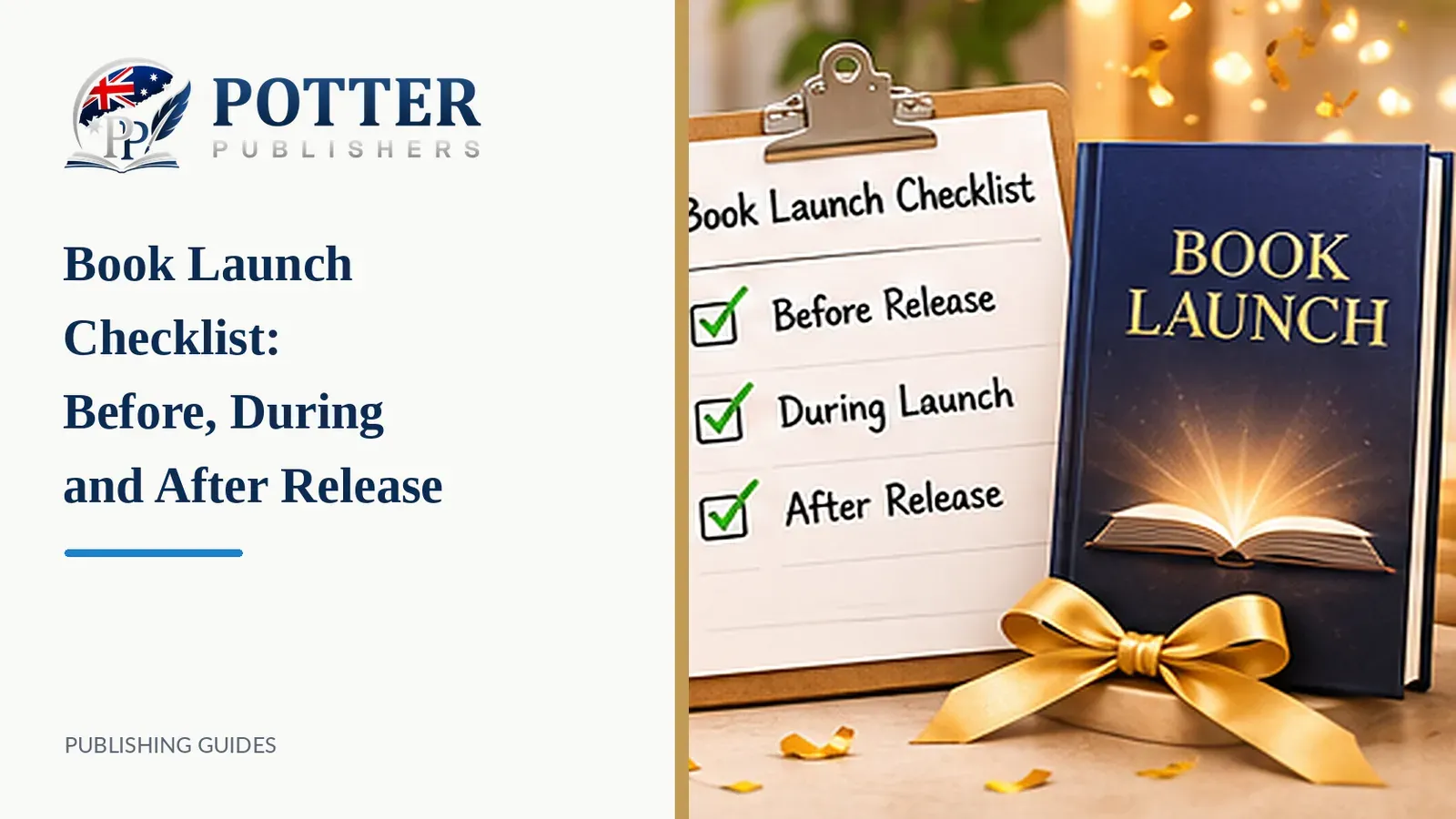
A strong launch gives your book its best chance with readers and retailers. Use this checklist to plan the work in the right order.
Potter Publishers plans launches for authors across Australia and the United States, and this checklist reflects the order we tackle the work in. Use it on its own, or alongside our book launch marketing and book marketing services.
Two to three months before launch
- Finalise editing, cover and interior files.
- Register ISBNs and set up your retailer listings.
- Write a strong description and choose categories and keywords.
- Prepare advance reader copies and line up early reviewers.
- Update your author website and email signup.
Two to four weeks before launch
- Order and approve printed proofs.
- Prepare launch graphics and a short content calendar.
- Plan any advertising and agree your budget.
- Brief your email list and community about the date.
Launch week
- Confirm the book is live and displaying correctly on every retailer.
- Send your launch email and share your posts.
- Thank early readers and remind them about reviews.
- Start any planned campaigns.
After launch
- Review results against the goals you set.
- Keep collecting reviews.
- Adjust advertising based on what is working.
- Plan your next promotion or book.
Set your goals before you start
A launch without goals is hard to judge. Before you begin, decide what success looks like for this book: a number of early reviews, growth in your email list, visibility in a category, bookings for talks, or sales over the first months. Clear goals make it easier to decide where to spend time and money, and to measure what worked afterwards.
Building your launch team
Early readers make a real difference. Invite readers who enjoy your genre to read an advance copy, give them clear dates, and make it easy for them to share honest reviews where the retailer's rules allow. Friends and family are welcome supporters, but readers who genuinely enjoy the genre write the most useful reviews.
Preparing your retailer listings
Your listing does a lot of selling. Write a description that opens with a hook, makes the genre clear and ends with a reason to buy. Choose categories that fit and where your book can be seen, and use relevant keywords. Check that your author bio, cover and look-inside preview all display correctly before launch day.
Launch content that works
- A short announcement for your email list
- Cover reveal and launch-day graphics
- A short excerpt or behind-the-scenes post
- Quotes from early readers, used with permission
- Details of any launch event, reading or interview
Using advertising wisely
Advertising can amplify a launch, but it works best once your listing, reviews and cover are strong. Start with a modest budget you are comfortable with, test, and keep what performs. Paid ads cannot fix a weak listing, so get the foundations right first.
After the launch: keep the momentum
Most books need sustained effort beyond launch week. Plan follow-up promotions, keep building your email list, pitch relevant podcasts, blogs or events, and use what you learned to plan the next book. A launch is the start of the book's life, not the end of your marketing.
A month-by-month launch timeline
Three months before: confirm your publication date, finalise editing and design, register ISBNs and start building your list of early readers.
Two months before: set up retailer listings, prepare your description and author bio, and send advance copies to early readers.
One month before: approve printed proofs, prepare your launch graphics and emails, and confirm any events, interviews or guest posts.
Launch week: confirm your book is live everywhere, send your announcement, thank your supporters and start any planned promotions.
The months after: review results, keep encouraging reviews, try new promotions and plan your next book.
Local and community opportunities
Depending on your book, local opportunities can be valuable: readings at libraries and bookshops, talks to community groups, school visits for children's books, or events connected to your book's subject. Local media and community newsletters may also be interested in a story about a local author.
Measuring what worked
After the launch, compare the results with the goals you set: reviews gathered, changes in your email list, visibility and sales trends. Note which activities brought the most response and which took the most effort for the least return. These notes will make your next launch easier and more effective.
Looking after yourself during a launch
Launches can be intense. Plan the work in advance, share tasks where you can, and set realistic expectations. A steady, sustainable approach over the months after launch usually achieves more than an exhausting single week.
Key takeaways
- Set clear goals for the launch before you start.
- Start planning two to three months before release.
- Prepare strong retailer listings and an early reader team.
- Use advertising to amplify a strong foundation, not to replace it.
- Keep promoting after launch week and measure what worked.
A good launch is planned, steady and measured. Use this checklist to stay organised, and adapt it to your book, your readers and the time you have available.
How Potter Publishers can help
See our book launch marketing, book marketing and Amazon book ads services.
Related reading
Questions and next steps
When should I start planning? Ideally two to three months before release.
Can I relaunch an existing book? Yes. Many of these steps work for a relaunch too.
Do I need a launch event? Not necessarily. Events can help, particularly locally, but online launches and email lists are often just as effective.
Should I offer a discount at launch? Some authors use a short launch price to encourage early sales and reviews. Decide based on your goals and pricing strategy.
Want help with your launch? Potter Publishers can build a plan around your goals and budget. Plan your launch with us.