
Book formatting, also called interior layout or typesetting, turns your final manuscript into print-ready and ebook-ready files. The cost depends far more on your book's content than on a fixed rate.
Formatting is one of the stages Potter Publishers handles for almost every book we publish, from text-only novels to illustrated children's books. Our formatting and ebook formatting teams quote each interior individually, and this guide explains why.
What drives the cost
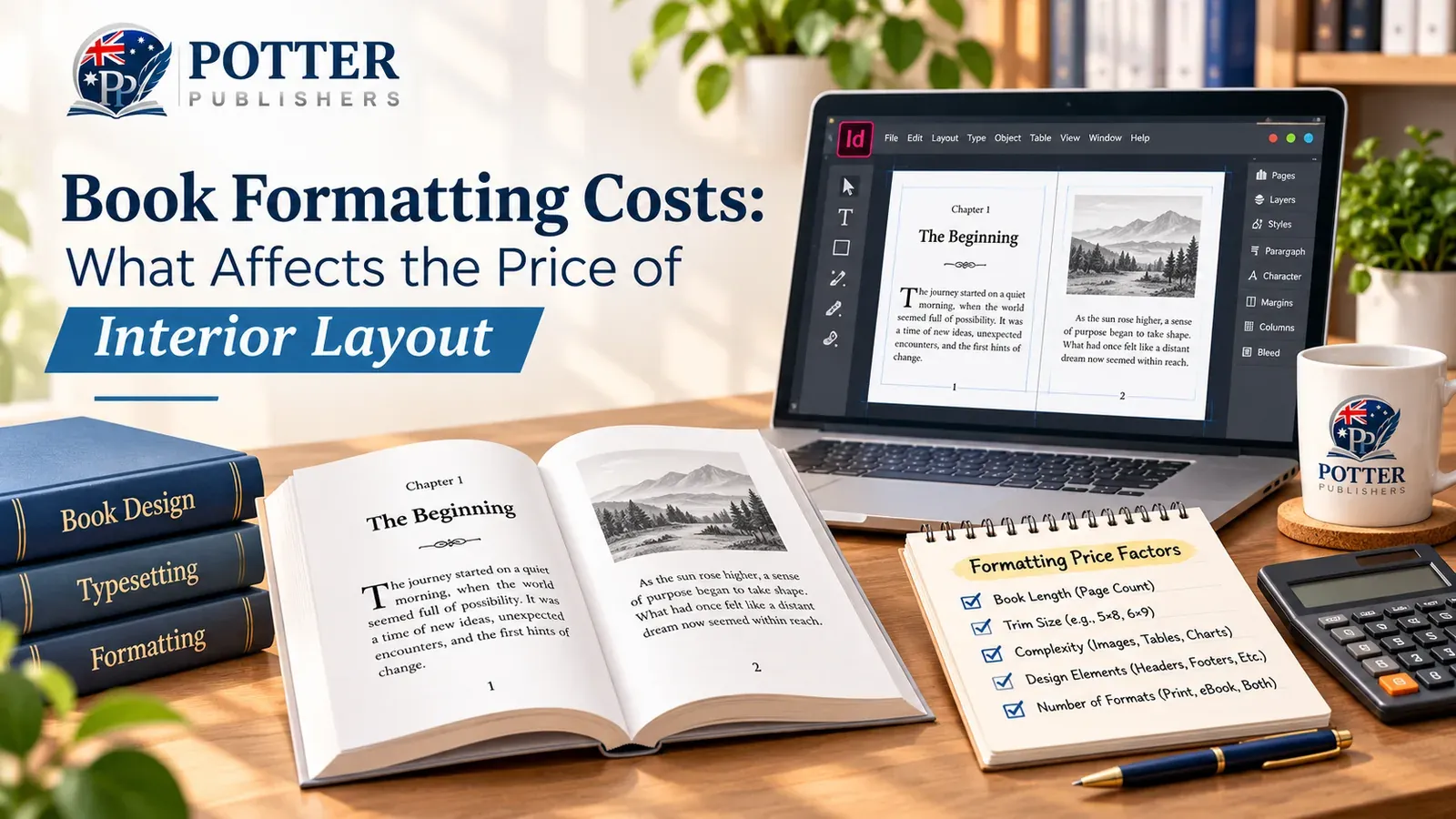
- Page count and trim size. Longer books take longer to lay out.
- Formats. Print only, ebook only or both; each format needs its own file.
- Complexity. Images, tables, footnotes, poetry and sidebars all need individual handling.
- Design level. A clean, standard interior costs less than a custom design.
- Corrections. Rounds of changes after the proof.
Print vs ebook
Print formatting is a fixed layout built to the printer's specifications: margins, gutter, fonts, headers and how text breaks across pages. Ebooks are usually reflowable and must work on many devices. Illustrated books and cookbooks may need fixed-layout ebooks, which take more work.
Save money by finalising your text first
Format only after editing is finished. Changes made after layout can shift pages, introduce errors and cost extra rounds.
What professional formatting includes
A professional interior goes well beyond choosing a font. It typically covers the trim size and margins, body and heading typography, chapter opening design, running headers and page numbers, front matter such as the title page, copyright page and contents, back matter such as acknowledgements and the author bio, and careful control of how text breaks across pages. For ebooks it covers clean structure, a linked table of contents, image handling and testing on devices.
Simple and complex interiors
A novel with plain text and chapter headings is the simplest kind of interior. Costs and time rise with complexity: nonfiction with several heading levels, lists and callouts; books with footnotes or endnotes; poetry, where every line break matters; cookbooks with recipes and photography; and illustrated or children's books that need fixed layouts.
Common formatting problems that cost authors money
- Sending a manuscript that is still being edited, which leads to repeated layout changes.
- Low-resolution images that cannot be printed clearly.
- Inconsistent styles in the source file, which take time to clean up.
- Choosing a trim size before checking the printer and genre conventions.
- Skipping a proofread of the formatted file.
Preparing your files
You can reduce time and cost by delivering a clean, final manuscript: consistent heading styles, no manual spacing to create layout, images supplied separately at full resolution, and a short brief describing the look you want with a few example books you admire.
Templates versus custom design
Template-based formatting can produce a clean, professional result for straightforward books. A custom interior suits books where design is part of the reading experience, such as memoirs with photographs, gift books, poetry and illustrated nonfiction. Ask which approach a quote is based on.
What to ask before you hire a formatter
- Which formats and trim sizes are included?
- How many rounds of corrections are included after the proof?
- Will the files meet my printer's and retailers' specifications?
- Do I receive editable source files as well as final files?
Choosing a trim size
Trim size is the physical size of your printed book, and it affects how the book feels, how many pages it has and what it costs to print. Novels, memoirs, nonfiction, children's books and workbooks each tend to follow familiar sizes in their categories. Before choosing, look at comparable books on the shelf, check which sizes your printer or platform supports, and remember that a smaller trim size usually means more pages for the same text.
Fonts and readability
Body text should be comfortable to read for long periods. Professional formatters choose typefaces designed for book text, set a comfortable size and line spacing, and check that the font is licensed for embedding in print and ebook files. Headings and chapter titles can be more distinctive, but they should complement the body text rather than compete with it.
Front and back matter
Readers rarely notice front and back matter when it is done well, but they notice when it is missing. Typical front matter includes a half title, title page, copyright page, dedication and contents. Back matter may include acknowledgements, an author bio, a list of other books, and a call to join your email list. Decide what you want to include before formatting begins, so it can be designed consistently with the rest of the book.
Ebook formatting is not a copy of print
Print layout features such as fixed page numbers, running headers and decorative page design do not carry over to reflowable ebooks. A good ebook is built for screens: clean headings, a working table of contents, images that scale, and text that reflows cleanly when the reader changes the font size. Treat the ebook as its own format, and test it on more than one device or app before release.
Key takeaways
- Formatting costs depend on page count, formats and the complexity of your interior.
- Print and ebook are different formats with different requirements.
- Finalise your text before formatting to avoid paying for extra rounds.
- Supply clean files and high-resolution images to save time.
- Always proofread the formatted file before you publish.
A professional interior makes a book comfortable to read and avoids rejected uploads. Preparing your files well and knowing what to ask your formatter will help you get a polished result within your budget.
How Potter Publishers can help
We quote each interior individually. See our book formatting, ebook formatting and typesetting services.
Related reading
- Book cover design costs
- Amazon KDP vs IngramSpark
- What it costs to publish an ebook
- Editing vs proofreading
Questions and next steps
Can I format my book myself? You can, but professional formatting avoids retailer rejections and looks more polished.
Do I need separate files for paperback and hardcover? Often yes, because trim sizes and printer requirements differ.
Does formatting include the cover? Usually not. Covers are designed separately, although the cover's spine depends on the final interior page count.
Can formatting change my page count? Yes. Font size, margins and trim size all affect page count, which also affects print cost and spine width.
Potter Publishers can prepare print-ready and ebook files that meet retailer requirements. Request a formatting quote.