
Hiring help to publish your book can be one of the best decisions you make, or one of the most expensive mistakes.
For every honest publishing service, there's a company that makes its money from author fees instead of book sales. Some target first-time authors with flattering emails and packages costing thousands of dollars. Before you sign with any book publishing company, check it against these 10 red flags.
1. They Contact You First and Promise Success
Legitimate services rarely cold-message authors to say they "discovered" your book. If a company reaches out through ads, email, or social media saying your book will be a bestseller, as long as you pay a fee first, be very careful.
Good sign: The company is honest about what it can't promise. No one can guarantee sales.
2. They Keep a Share of Your Royalties
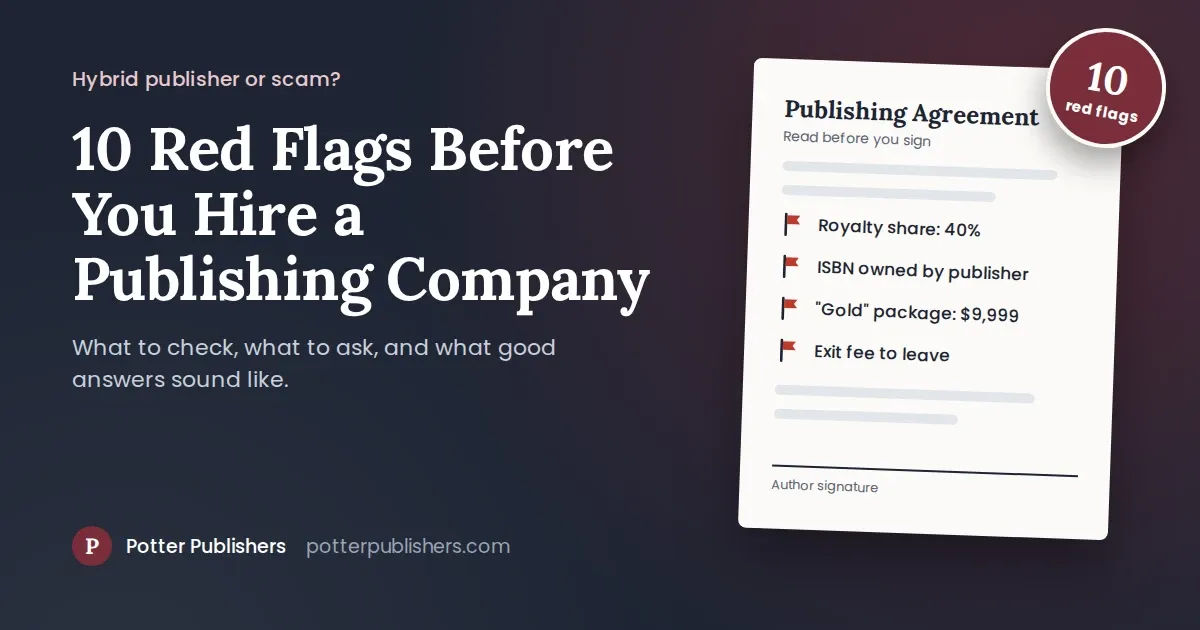
This is the most expensive red flag, and it's easy to miss. Many hybrid publishers charge an upfront fee and keep a percentage of your royalties for as long as the book is on sale. A 30 to 50 percent cut can cost you far more over the years than the original fee.
Good sign: You pay once for the work, and 100 percent of your royalties go straight to your bank account.
3. The ISBN Is Registered in Their Name
Whoever owns the ISBN is listed as the publisher. If a company registers your ISBN under its own name, it becomes much harder to move your book elsewhere later.
Good sign: The ISBN is registered in your name or your own imprint's name.
4. Your KDP and Retailer Accounts Belong to Them
If your book is uploaded to their Amazon KDP account, they control your price, your sales data, and when you get paid. You're relying on their honesty every single month.
Good sign: Every retailer account is set up under your own login, and they work in it with your permission.
5. They Sell "Gold, Silver, Bronze" Packages
Tiered packages look simple, but they often bundle services you don't need, like press releases no one reads or "social media promotion" with no measurable results. Be especially careful with packages in the $2,000 to $20,000 range sold by companies that found you through ads.
Good sign: Services are priced one by one, and the company tells you which ones you can skip.
6. There's No Clear, Written Quote
Vague pricing, extra costs that appear later, or pressure to pay before you've seen a detailed quote are all warning signs.
Good sign: You get an itemized written quote after they've actually looked at your manuscript. For typical price ranges, see our guide to the cost to publish an ebook in 2026.
7. They Pressure You to Decide Fast
"This discount ends tonight" or "we only have one slot left this month" are sales tactics, not publishing advice. A good partner gives you time to read the contract and compare options.
Good sign: A free, no-obligation consultation, and honesty if they aren't the right fit for your book.
8. You Can't Leave Without Paying
Read the termination section of the contract. Watch out for long lock-in periods, fees to get your rights back, or clauses that keep your files, cover, or edits after you leave.
Good sign: If you leave, you take your book, your rights, your files, and your sales data with you.
9. Their Published Books Don't Look Professional
Look up books they've published on Amazon. Check the covers, open the "Look Inside" preview, and read the reviews. Weak covers and typos in the first pages tell you what your book might look like.
Good sign: A public portfolio of real books by real authors that you can check on retailer sites.
10. There Are No Independent Reviews
Testimonials on their own website are a starting point, not proof. Check independent review platforms and watchdog resources like the Alliance of Independent Authors' services watchdog.
Good sign: Verified reviews on third-party sites, such as Trustpilot, alongside their client testimonials.
8 Questions to Ask Any Publishing Company Before You Pay
| Ask this | A good answer | Potter Publishers' answer |
|---|---|---|
| Do you take a share of my royalties? | No | No. You keep 100%. |
| Whose name is the ISBN in? | Yours | Yours |
| Whose KDP and retailer accounts will you use? | Yours | Yours, under your own login |
| Can I choose individual services? | Yes | Yes. There are no package tiers. |
| Will I get a written quote first? | Yes, itemized | Yes, within 48 hours of a free review |
| What happens if I leave? | I keep everything | You take your book, rights, and data |
| Where will my book be sold? | A clear list of retailers | Amazon, IngramSpark, Apple Books, Kobo, and 40+ more |
| Can I see books you've published? | Yes | Yes. See our portfolio. |
Hybrid Publishing vs Self-Publishing Services vs Vanity Press
Self-publishing service: You hire professionals for specific jobs, like editing, a cover, or distribution setup. You own everything and keep all royalties.
Hybrid publisher: You share costs and royalties with a publisher that is selective about what it publishes. This can be legitimate, but read the royalty and rights terms carefully.
Vanity press: It accepts almost anyone, makes its money from author fees, and often keeps rights or royalties. Avoid.
Still deciding between self-publishing and a traditional deal? Read Self-Publishing vs Traditional Publishing: Which Is Right for Your First Book?
How Potter Publishers Works
We built Potter Publishers to be the opposite of every red flag above.
Publishing: Editing, formatting, ISBN registration, and distribution through our book publishing services.
Covers: Genre-matched, human-designed covers through our book cover design service.
Writing: Original manuscripts, written with you, through our ghostwriting service.
Children's books: Illustration and publishing through our children's book service.
We work with indie authors in more than 20 countries from our offices in Hobart, Tasmania, and Billings, Montana. Learn more about us.
Frequently Asked Questions
What is the difference between a hybrid publisher and a vanity press?
A legitimate hybrid publisher or publishing service is selective, transparent about costs, and gives you real editorial and distribution work. A vanity press accepts almost anyone, earns its money from author fees rather than book sales, and often keeps rights or royalties.
Should I ever pay a publisher?
Traditional publishers should never charge you. Paying a self-publishing service is normal, as long as you're paying for clearly defined work and you keep your rights, ISBN, accounts, and royalties.
Who should own my ISBN and KDP account?
You should. If the ISBN or retailer accounts are in the company's name, they control your book, your sales data, and your payments.
How can I check if a publishing company is legitimate?
Check independent reviews, ALLi's self-publishing services watchdog ratings, and the company's published books on Amazon, and read the full contract before paying anything.
Related reading: How Much Does It Cost to Publish an eBook in 2026? and Amazon KDP Changes 2026.