
An ISBN, or International Standard Book Number, identifies a specific edition of a book. If you are an Australian author publishing independently, here is what you need to know.
Potter Publishers lists its Australian address in Hobart and works with authors across the country, including in Sydney and Melbourne. ISBNs are one of the first practical questions Australian independent authors ask us about, so here is a clear guide.
Where to get ISBNs in Australia
In Australia, ISBNs are issued by Thorpe-Bowker, the national ISBN agency. You can buy them individually or in blocks.
One ISBN per format
Each format needs its own ISBN: paperback, hardcover, ebook and audiobook are separate editions. A new edition with significant changes usually needs a new ISBN too.
Publisher of record
Whoever buys and registers the ISBN is recorded as the publisher. If you buy your own, you or your imprint are the publisher of record. Some platforms offer free identifiers, but these may list the platform as publisher or only work on that platform.
After you publish: legal deposit
Australian legal deposit generally requires published books to be deposited with the National Library of Australia and the relevant state library. Check the current requirements for your state.
What an ISBN does and does not do
An ISBN is an identifier. It lets retailers, distributors and libraries tell editions apart and order the right one. It does not grant copyright, protect your work, or guarantee sales or distribution. In Australia, copyright protection generally applies automatically when you create an original work; the ISBN is about identification and the book trade.
How many ISBNs you need
Count the formats you plan to publish: a paperback, a hardcover, an ebook and an audiobook would each need their own ISBN. If you plan a series or future editions, buying ISBNs in a block can make sense. Check the current options and pricing with the agency.
Registering your details
When you assign an ISBN to a book, you record its details: title, author, format, publisher, publication date and price. Accurate details help the book trade find and order your book. Keep a simple spreadsheet of which ISBN belongs to which edition, so nothing is reused by mistake.
Using your own imprint name
Many independent authors publish under an imprint name rather than their own name. If you do, use it consistently on the ISBN registration, the copyright page and your retailer accounts. An imprint can look more established, and it is useful if you plan to publish several books.
Free platform identifiers
Some publishing platforms offer free identifiers. These can be convenient, but they may list the platform as the publisher or be usable only on that platform. If you want to be the publisher of record and keep your options open across retailers and distributors, owning your ISBNs is usually the better choice.
A checklist for Australian authors
- Decide your formats and how many ISBNs you need
- Buy ISBNs in your own name or your imprint's name
- Assign one ISBN per format and record the details
- Print the ISBN on the copyright page and barcode on print covers
- Meet your legal deposit obligations after publication
ISBNs for different editions
A new ISBN is generally needed when you publish a new format or a new edition with significant changes, such as substantial new content or a change of publisher. Minor corrections, such as fixing typos, usually do not require a new ISBN. If you are unsure whether a change counts as a new edition, check the current guidance from the ISBN agency before you publish.
Audiobooks and ISBNs
Audiobooks are a separate format and are often assigned their own ISBN, although some audiobook platforms do not require one. If you plan to publish an audiobook, decide early whether you want an ISBN for it, so you can include it in your planning and records.
ISBNs and international sales
An ISBN identifies your edition worldwide, so an Australian-issued ISBN can be used when your book is sold in other countries. If you publish a separate edition for another market, for example with different spelling or a different cover, it may need its own ISBN. Keep your records clear so retailers in each market see the correct edition.
Keeping your ISBN records organised
A simple record of every ISBN you own, which book and format it belongs to, its publication date and its status saves confusion later, especially as you publish more books. Store it alongside your other publishing records, such as account details for retailers and distributors, so everything is in one place.
Key takeaways
- In Australia, ISBNs are issued by Thorpe-Bowker.
- Each format, such as paperback, hardcover, ebook and audiobook, needs its own ISBN.
- Whoever registers the ISBN becomes the publisher of record.
- Free platform identifiers can be convenient but limit your options.
- Remember your legal deposit obligations after publication.
Owning your ISBNs keeps you in control of your books as you publish more formats and titles. A little organisation at the start saves confusion later, especially if you plan a series or several editions.
How Potter Publishers can help
We help authors register ISBNs in their own name. See our ISBN registration and self-publishing services, and our services for Australian authors.
Related reading
- Amazon KDP vs IngramSpark
- Can you publish an AI-written book in Australia?
- Self-publishing vs traditional publishing
- Amazon KDP changes in 2026
Questions and next steps
Do ebooks need an ISBN? Not on every platform, but owning one gives you more control and wider distribution options.
Can I use the same ISBN in other countries? Yes. An ISBN identifies the edition worldwide.
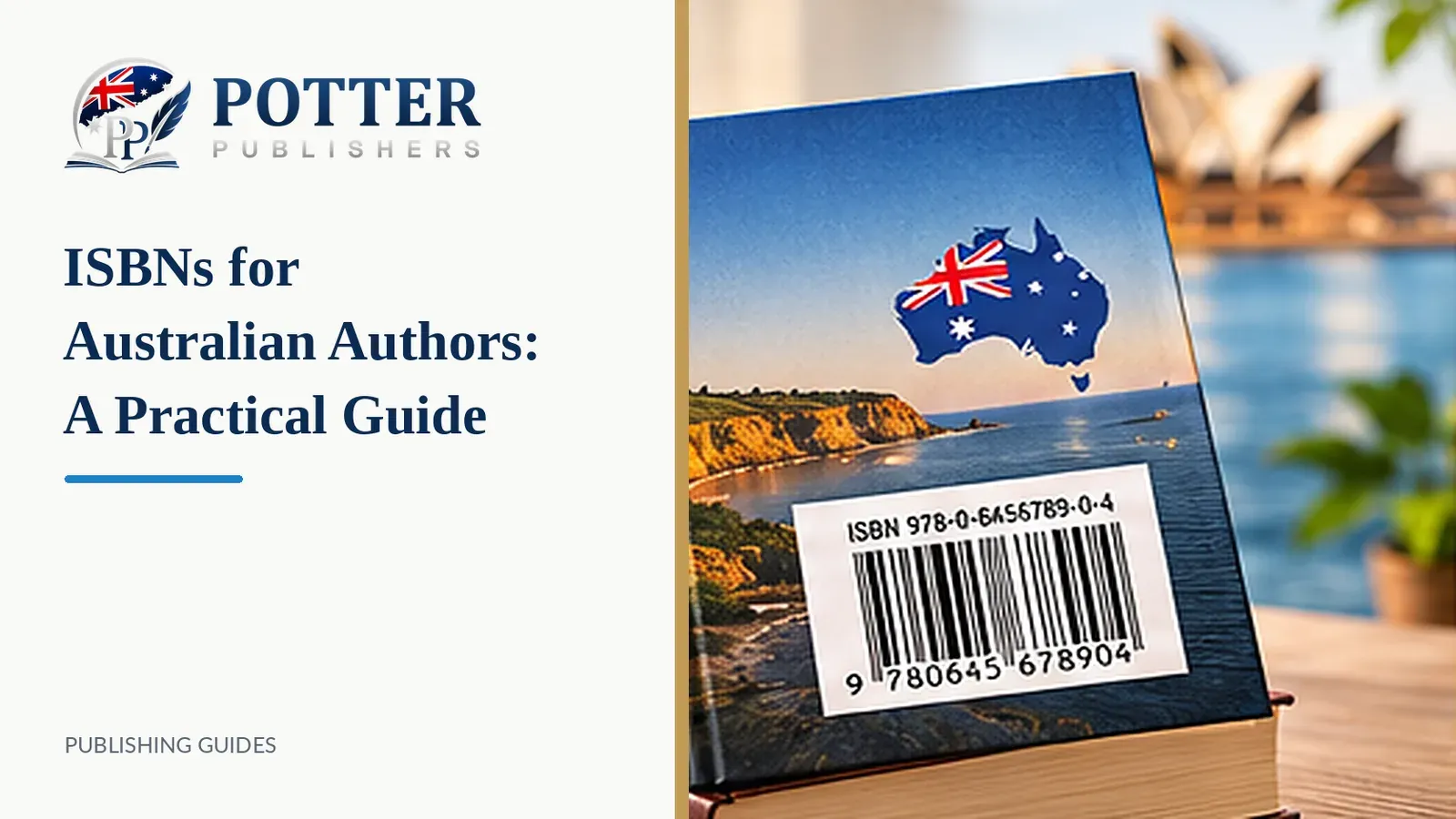
Do I need a barcode? Print books sold through retailers generally need a barcode that encodes the ISBN on the back cover. Your cover designer can place it.
Can I transfer an ISBN to another book? No. Once assigned to an edition, an ISBN stays with that edition.
Potter Publishers can help you register ISBNs in your own name and set up your editions correctly. See our ISBN registration services or contact our team.