
If you publish on Amazon, 2026 has already changed the rules more than once. Pre-order windows have grown, DRM settings now control whether readers can download your ebook as an EPUB or PDF, and Kindle Unlimited payouts have fallen from their summer high.
Here is a plain-English guide to the Amazon KDP changes in 2026, what each one means for your ebook, and what to do next.
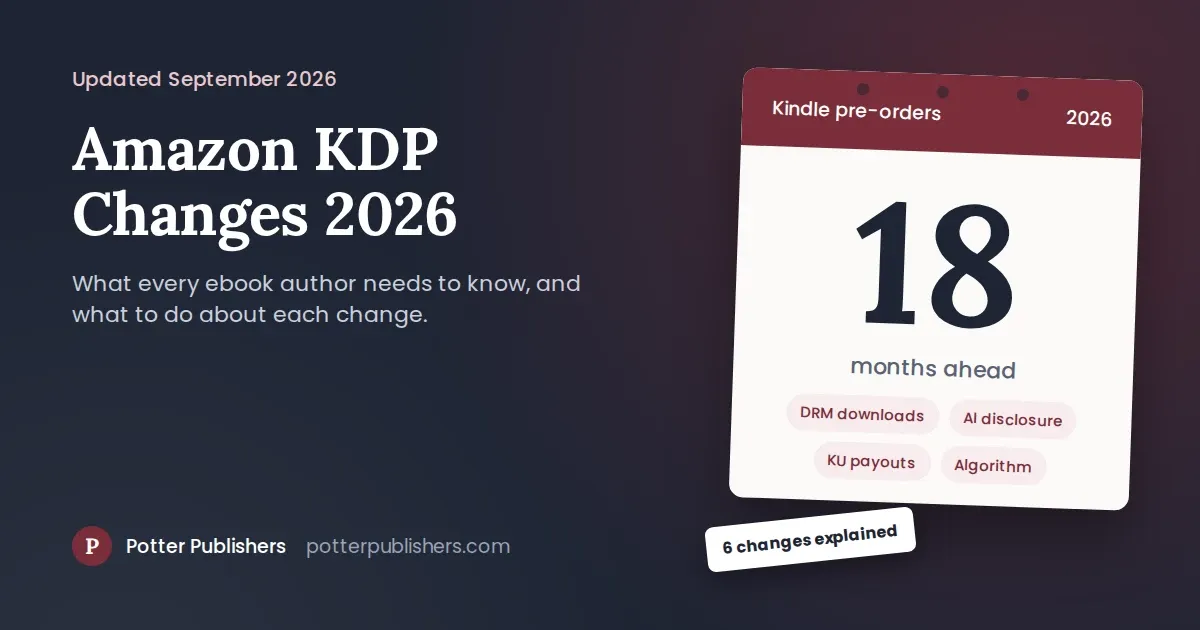
1. Kindle eBook Pre-Orders Now Run Up to 18 Months
This is the newest change and one of the most useful. For pre-orders created on or after September 2, 2026, you can set a release date up to 18 months ahead. Pre-orders created before that date keep the one-year limit (see KDP's pre-order help page).
You also get more room to adjust your date. New pre-orders can be postponed up to two times, as long as the new release date stays within six months of the original one. Penalties are also lighter. A second missed deadline or cancellation now suspends your pre-order privileges across your whole catalog for six months, and they come back automatically after that.
What this means for you
- Series authors can put book two, and even book three, on pre-order at the launch of book one. Readers who finish your first book can buy the next one straight away.
- You can start marketing earlier. An 18-month window gives you time to collect pre-orders from your email list, social media, and advance readers.
Watch out for these limits
- This applies to Kindle ebooks only. KDP still doesn't offer true pre-orders for paperbacks or hardcovers.
- Your final manuscript must be uploaded 72 hours before release, or the pre-order is cancelled.
Our tip: Only set a pre-order when your edited manuscript and final cover are nearly ready. A missed deadline costs you pre-order privileges on every book, not just one. If you want help hitting deadlines, see our book publishing services, which include launch coordination.
2. KDP's DRM Setting Now Decides Whether Readers Can Download Your eBook
This change took effect at the start of 2026, and many authors still haven't noticed it. From January 2026, ebooks published without DRM (Digital Rights Management) can be downloaded as EPUB or PDF files. That means readers can move them to Kobo, Apple Books, or any other reading device.
A few details matter here:
- It only applies to titles published after December 9, 2025. Older non-DRM titles don't get the EPUB and PDF download option (see KDP's DRM settings page).
- Some authors have found that their DRM setting was switched to "off" without them changing it. Check yours.
Which setting should you choose?
- Turn DRM off if you care most about reader goodwill and reach, or you plan to publish on other platforms anyway.
- Turn DRM on if you're worried about your files being shared. This is especially worth considering for high-value nonfiction, workbooks, and courses.
3. Disclosing AI Use Is Now a Real Compliance Issue
Amazon's content guidelines ask you to disclose AI-generated content when you publish. This covers text, images, and translations that an AI tool created. Content that is only AI-assisted, such as brainstorming ideas or editing text you wrote yourself, generally doesn't need to be disclosed.
Enforcement against low-quality AI books has reportedly increased sharply in 2026. Companion guides and summary-style books, which were a common format for low-effort AI publishing, have been largely prohibited. Identity verification is also now a condition of publishing.
What this means for you
- Be honest on the AI disclosure question. Getting it wrong can put your whole account at risk.
- AI-generated cover art counts as AI-generated content. A professionally designed cover avoids this question completely. See our book cover design service.
- If you need help writing your book, a human ghostwriter produces original work you can publish with confidence. See our ghostwriting service.
4. Kindle Unlimited Payouts Dipped After a Record Summer
If you're enrolled in KDP Select, your per-page earnings are worth watching. Kindle Unlimited payouts to authors fell to $69.4 million in August 2026, down from a record $71 million in July.
One month's dip isn't a crisis, but it's a reminder that relying on a single platform is a business risk. After a year of changing royalty terms and the sudden shutdown of distributors like Baker & Taylor, more authors have been looking into publishing wide.
Should you stay exclusive or go wide?
| KDP Select (exclusive) | Wide distribution | |
|---|---|---|
| Income source | Kindle Unlimited page reads | Sales across many stores |
| Retailers | Amazon only | Apple Books, Kobo, Google Play, B&N, and more |
| Best for | Fast-reading genres like romance, thrillers, and fantasy | Nonfiction, international readers, and library sales |
| Risk | Depends on one company's rules and payouts | More work to set up and manage |
We can set up distribution to Amazon, IngramSpark, Apple Books, Kobo, and 40+ other retailers, all under your own accounts.
5. Amazon's Algorithm Rewards Conversion and Real Reviews
Amazon doesn't publish how its ranking works, but industry observers agree on two points for 2026:
- Conversion rate matters more than sales spikes. If many people click on your book but few buy it, Amazon shows it less.
- Steady, genuine reviews beat sudden bursts. Amazon increasingly favors reviews that arrive naturally over time.
What actually moves conversion
Cover: It's the first thing a shopper judges, and it decides whether they click.
Book description: It turns a curious clicker into a buyer.
Look Inside preview: Clean interior formatting builds trust.
Price: It should match what similar books in your genre charge.
6. Bonus: AI Audiobooks Are Going Mainstream
Audio is changing fast too. Spotify has opened its AI audiobook creation tool to all US authors. It's free for up to five titles and doesn't require exclusivity.
AI narration is cheap, but for fiction, memoir, and children's books, a human narrator still makes a real difference to how listeners experience the story. Potter Publishers coordinates studio-recorded audiobooks with narrators you audition yourself. Book a free consultation to find out whether audio makes sense for your book.
Your 2026 KDP Checklist
- Check the DRM setting on every ebook in your KDP Bookshelf.
- Re-read KDP's AI content guidelines and update any disclosures.
- Plan your next release as an ebook pre-order, and give yourself a buffer before the 72-hour upload deadline.
- Review your Kindle Unlimited income against the option of going wide.
- Improve conversion by reviewing your cover, book description, and preview pages.
- Consider an audiobook edition.
Is Self-Publishing Still Worth It in 2026?
Yes, as long as you treat it like a business. More authors now self-publish than ever, which means readers have more choice and your book needs to look professional to stand out. If you're still deciding which route to take, read our guide: Self-Publishing vs Traditional Publishing: Which Is Right for Your First Book?
How Potter Publishers Helps You Stay Ahead of KDP Changes
We keep up with KDP's rules so you don't have to. Our services include:
Publishing: Editing, formatting, ISBN registration, and retailer account setup through our book publishing services.
Design: Original, human-made covers through our book cover design service.
Writing: Original manuscripts through our ghostwriting service.
Children's books: Illustrated picture books through our children's book publishing service.
You keep 100% of your rights and royalties. See real books we've launched in our portfolio, and read what authors say in our testimonials.
Frequently Asked Questions
How far in advance can I set up a Kindle pre-order in 2026?
You can set it up to 18 months in advance for ebook pre-orders created on or after September 2, 2026. Earlier pre-orders keep the 12-month limit.
Can I set up a pre-order for my paperback on KDP?
No. KDP offers pre-orders for ebooks only. For print books, you can schedule a release date, but customers can't order ahead of launch.
What happens if I publish my Kindle ebook without DRM?
For titles published after December 9, 2025, readers can download non-DRM ebooks as EPUB or PDF files and read them on other devices.
Do I have to disclose AI use on Amazon KDP?
You must disclose AI-generated text, images, or translations. AI-assisted work, such as editing or brainstorming for content you created yourself, generally doesn't need to be disclosed. Always check KDP's current guidelines.
Are Kindle Unlimited payouts going down in 2026?
They dipped in August 2026 to $69.4 million, down from July's record of $71 million. Payouts change every month.